Showing posts with label war heroes. Show all posts

Sunday, April 14, 2013

THE INTER-WAR YEARS 1919-39

SOMALILAND

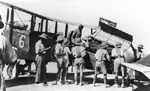
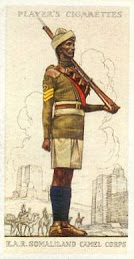
The first campaign to explore the possibility of exploiting air power's reach and power in this manner took place in British Somaliland in the Horn of Africa. A Muslim cleric Mohammed bin Abdullah, colloquially, if inaccurately known as "The Mad Mullah", had proved a thorn in the flesh of the colonial administration for many years and had frustrated repeated attempts to bring law and order to the area. In 1920 his activities had reached such a pitch that the Colonial Office again wished to take military action against him and his large band of armed followers. The British Army estimated that this would require a full scale expeditionary force involving 2 or 3 divisions of troops and attendant bag and baggage at a cost of several million pounds. Trenchard, however, offered to do the job using one squadron of de Havilland DH9s, in collaboration with the local gendarmerie regiment, the Somaliland Camel Corps and a battalion of the King's African Rifles. His offer was accepted and the Squadron of 12 aircraft, to be known as "Z Force" was shipped to the area.


In a matter of weeks, operating in conjunction with the Camel Corps, Z Force successfully bombed and harried the Mullah's forces, driving them from their traditional stone forts. The entire campaign cost in the region of £100,000, and it was said afterwards to be the "cheapest war in history". The political effects for the RAF were out of all proportion to the local impact in Somaliland. The RAF had demonstrated its ability to undertake effective police actions


DH9 Air Ambulance with Z Force British Somaliland 1919

Source: http://www.raf.mod.uk/rafcms/mediafiles/F21C6257_ABD1_7132_E8716B8C2DA98948.pdf

Monday, May 19, 2008

Air Chief Marshal Sir John Barraclough

Wartime flying boat pilot of high ability who made his career in the RAF and flew more than 70 types of aircraft.


Air Chief Marshal Sir John Barraclough
Barraclough [right] ready for his flight in a Tornado to mark his retirement as Inspector of the RAuxAF in 1995

Air Chief Marshal Sir John Barraclough, who died on Saturday aged 90, gave an exceptionally long period of devoted service to the Crown and to defence affairs; after serving in the RAF for 38 years, in retirement he conducted various studies for the Air Force Board and the Chiefs of Staff before becoming the Inspector-General of the Royal Auxiliary Air Force.

During the Second World War Barraclough flew continuously on maritime air duties with Coastal Command and in the Indian Ocean. Before the war he flew Ansons with No 269 Squadron from Abbotsinch, near Glasgow, and, in a foretaste of what lay ahead, he was engaged in the air searches for the submarine Thetis when it failed to surface in Liverpool Bay in 1939.

On the outbreak of war he converted to flying boats, and in 1940 he operated with No 240 Squadron from the Shetland Islands. Flying over the northern North Sea he flew in support of the ill-fated British Expeditionary Force to Norway and on searches for German ships seeking to break out from the Baltic.


After a period flying anti-submarine patrols and convoy escorts off the west coast of Scotland, he was made chief instructor of the Flying Boat Conversion Unit at Invergordon, where he was awarded an AFC for developing innovative methods of operational training.

In February 1942 Barraclough reformed No 209 Squadron, equipped with the Catalina flying boat, before leaving in June for the Indian Ocean to support the Eastern Fleet for the Madagascar campaign.

Operating with the barest facilities from Comoro Island in the Mozambique Channel, and from other island bases, he flew intensive operations and was awarded a DFC. "This officer," the citation concluded, "has shown the greatest devotion to duty and is a born leader of men."

Barraclough continued to operate with No 209 over vast areas of the Indian Ocean, providing convoy escorts and seeking out U-boats and their mother ship, Elizabeth Schliemann.

Promoted to wing commander at the age of 24, he commanded the captured Italian airfield at Mogadishu, Somaliland, where Wellingtons conducted anti-submarine operations. On his return to Britain in May 1944 he became chief instructor at a flying-boat training unit and was mentioned in dispatches.

John Barraclough was born at Hounslow on May 2 1918 and educated at Cranbrook School. After three years' volunteer service with the Artists' Rifles while working in the City of London, in 1938 he was granted a four-year commission in the RAF to train as a pilot.

At the end of the war Barraclough was negotiating his admission to the Middle Temple as a student when he was offered a permanent commission in the RAF, which he accepted.

After completing a period of service in Egypt, he joined the Central Flying School and was appointed to its examining wing, first as a flight commander and then in command of the wing responsible for the flying instructional standards in the RAF and in many other national air forces which held the RAF in esteem.

As a staff officer at the headquarters of Training Command, he wrote an imaginative paper on the pros and cons of using a basic jet aircraft for initial pilot training, and this paved the way for the introduction into service of the long-serving Jet Provost aircraft.

Barraclough was always a restive staff officer who hankered after action – in his career he flew more than 70 different types of aircraft – and he was able to persuade his commander-in-chief that he should take the first Vampire training aircraft on a trial flight to Southern Rhodesia.

With few navigation aids, Barraclough and his fellow pilot completed the 10,000-mile round trip in the cramped cockpit of the short range, single-engine jet without mishap. He was awarded a Queen's Commendation for Valuable Services in the Air.

After commanding the two fighter stations at Biggin Hill and Middleton St George (now Durham Tees Valley Airport), he served in the Far East during the campaign against the Communist terrorists in Malaya.

On promotion to air commodore in 1960 he took up the post of director of public relations at the Air Ministry, where he was deeply involved in defending the philosophy and strategy of nuclear deterrence then exercised by Bomber Command; he also defended (in the end unavailingly) the emerging TSR2 from its political opponents. His efforts on these sensitive issues were recognised with a CBE.

On completing his time as AOC No 19 Group in Coastal Command, Barraclough took a sabbatical and, at his own expense and on unpaid leave, enrolled on the advanced management course at Harvard Business School.

On his return in 1968 the RAF appointed him Air Officer (Administration) of Bomber Command to manage the imminent, and highly emotional, mergers of Bomber, Fighter, Coastal and Signals Commands. Such was his success that he was promoted and appointed CB.

He served as Vice-Chief of the Defence Staff before becoming the Air Secretary, an appointment he did not relish. His final post before retiring from the RAF in 1978 was as Commandant of the Royal College of Defence Studies. He was appointed KCB in 1970.

Barraclough had a sharp intellect, a dry wit and boundless energy and enthusiasm. He was an eloquent and persuasive writer, and after retirement from the RAF was much in demand. For 12 years he served as a commissioner and vice-chairman of the Commonwealth War Graves Commission.

In 1976 he had been appointed an honorary air commodore in the Royal Auxiliary Air Force and, with the force employed in the ground defence role, he found himself very much at home as a former territorial rifleman.

For five years he was Inspector-General of the RAuxAF, during which time he was appointed a Gentleman Usher to the Sword of State with occasional ceremonial duties. He was able to take advantage of an informal opportunity after a State Opening of Parliament to seek the Queen's agreement to the award of a Colour.

This was granted, and in June 1989 750 serving members of the RAuxAF paraded at RAF Benson on the occasion of the presentation of the Queen's Colour.

On his farewell as the Inspector in 1995, Barraclough flew a bombing sortie in a Tornado. It was the 57th anniversary of his first flight in the RAF.

For six years in the 1970s he was editorial director of the defence magazine NATO's Nations. He was also a co-author, with General Sir John Hackett, of the best-selling book The Third World War, to which he contributed the air aspects.

In 1980 he became president of the Air Power Association, and the next year sponsored the Barraclough Trophy, awarded annually to the unit or individual member of the RAF who has made an outstanding contribution to RAF public relations in the previous year.

Barraclough was chairman of the Royal United Services Institute for Defence Studies, and then vice-chairman of the Air League, receiving its Gold Medal for distinguished services to British aviation. He was elected a Fellow of the Royal Aeronautical Society, and was a Liveryman of the Guild of Air Pilots and Air Navigators.

In 2002 he was approached to support an initiative to commemorate all those who had lost their lives in Coastal Command. He was appointed chairman of the Maritime Air Trust, which under his guidance and management launched a formidable fund-raising programme with the Duke of Edinburgh as its very supportive patron.

On March 16 2004 the Queen dedicated a sculpted tribute and roll of honour in the south cloister of Westminster Abbey. Barraclough – who, aged 86, handed over the reigns of the Trust to a former Chief of the Air Staff, Sir Peter Squire – always considered it an honour to have been associated with the project.

Barraclough lived in Bath, where in later years he was invited to be chairman, and later president, of the city's Royal Crescent Society, an organisation he led with his usual vigour in countering the adverse local effects of un-managed tourism.

He was a fine sailor and horseman. In the Admiral's Cup of 1973 he navigated the Irish yacht Clarion to success in her division of the Fastnet race. In the winter he rode regularly to hounds wherever he found himself, and he followed three-day eventing with keen interest.

He was a past-president of the RAF Modern Pentathlon Association and of the Combined Services' Equitation Association. He listed amongst his hobbies, "stilt walking (retired)".

John Barraclough was a tall man with a commanding presence but an unassuming manner. After being diagnosed with terminal cancer he displayed stoical courage.

Shortly before his death he paid tribute to his late wife Maureen (née McCormack), whom he had married in 1946 (and who died in 2001), writing that "her devoted and unselfish support during a taxing career was quite simply immeasurable". He is survived by their daughter.

source: http://www.telegraph.co.uk/news/obituaries/1947293/Air-Chief-Marshal-Sir-John-Barraclough.html

Friday, May 09, 2008

Squadron Leader 'Bam' Bamberger

From
February 20, 2008

Air ace who fought in the Battle of Britain and the defence of Malta

After joining the Auxiliary Air Force as a photographer before the war, “Bam” Bamberger saw action as a Spitfire pilot during the Battle of Britain, after which he was posted to Malta where he took part in the desperate air defence of the island during 1941. He was subsequently involved in fighter operations in support of the invasion of Sicily and the Eighth Army's drive up through Italy.

Cyril Stanley “Bam” Bamberger was born in Hyde, Cheshire, and educated locally. He left school at 14 and joined Lever Brothers as an electrical aprentice in 1934. In 1936 he volunteered for the Auxiliary Air Force and was posted as a photographer to 610 “County of Chester” Squadron, which had been formed that year as a bomber squadron at Hooton Park in the Wirral, not far from the company's Port Sunlight headquarters. He was accepted for pilot training in 1938, not long after which the squadron became a fighter unit and received its first Spitfires early in 1940.

In July 1940 the squadron was moved to Biggin Hill, and Bamberger flew with it as a sergeant pilot during the early air fighting over the Channel that followed the Dunkirk evacuation. The squadron suffered heavy casualties but Bamberger was credited with a “probable” Messerschmitt Me109 on August 28 in combat off the Kent coast.

When 610 was withdrawn to rest in mid-September Bamberger was posted to 41 Squadron and was soon back in action over Kent, where he gained his first confirmed combat victory, again over an Me109, on October 15.

With the Battle of Britain winding down, Bamberger volunteered for Malta, and on November 17, 1940, was in the Mediterranean aboard the aircraft carrier Argus from which a dozen Hurricanes were flown off, led by two naval Skuas, for the 450-mile flight to the island. As he was not familiar with the Hurricane he was not among those pilots selected to fly, and hence was spared the tragedy that ensued.

Many of the pilots, unused to long range flying, had set their engine revs too high for a flight of that length, and the navigator of one of the guiding Skuas was fresh from training school. Eight Hurricanes and one Skua ran out of fuel and were lost. The four fighters that reached Malta safely did so with respectively, 12, four, three and two gallons of petrol in their tanks.

Bamberger reached Malta in December in the destroyer Hotspur. With the island under heavy air attack, he was soon in thick of the action with 261 Squadron, and he shot down two Ju87 Stukas on successive days in January 1941 over Grand Harbour.

After a period back in the UK where he was commissioned and helped to train arriving American pilots in gunnery, he was back in the Mediterranean, this time as a flight commander with 93 Squadron, scoring further victories in the Sicilian and Italian campaigns before returning to Britain as a gunnery instructor in late 1944. By then his leadership and fine shooting had earned him the DFC and Bar.

After demobilisation he returned to Lever before joining the management of a Guinness subsidiary. When 610 Squadron was reformed as a Royal Auxiliary Air Force unit he rejoined it as a flight commander and became its CO in 1950, by when it had converted to Gloster Meteors. When the RAuxAF was mobilised after the outbreak of the Korean War he accepted a permanent commission, and for most of the duration of that conflict was an intelligence officer at the Air Ministry.

He later converted to helicopters and served in a squadron of Bristol Sycamores in Aden, finally retiring in 1959, by which time he had also received the Air Efficiency Award and Bar.

He then went into business, founding a packaging materials company, and then running an antiques business.He remained active in RAF matters and was closely involved with the Bentley Priory Battle of Britain Trust, of which he was vice-chairman.

“Bam” Bamberger is survived by his wife Heather, whom he married in 1954, and by three sons and a daughter.

Squadron Leader “Bam” Bamberger, DFC and Bar, AE and Bar, wartime fighter pilot, was born on May 4, 1919. He died on February 3, 2008, aged 88

Source: http://www.timesonline.co.uk/tol/comment/obituaries/article3398890.ece

Tuesday, April 29, 2008

Founder member Henry Allingham on the RAF at 90

Henry Allingham (Pic:PA)
Henry Allingham

It is 90 years today since the first Royal Air Force plane took to the skies. Henry Allingham, who at 111 years old is the only surviving founding member of the RAF, will be the guest of honour at RAF Odiham, Hampshire, to mark the anniversary. Here, with remarkable clarity for a man his great age, he tells Matt Roper of those early days.

By Matt Roper

1 April 2008

'I actually took my first flight three years earlier in 1915 and over all these years I remember it like yesterday.

It was still the Royal Naval Air Service then and I was the engineer in an Avro 504 biplane flying a reconnaissance mission over the North Sea.

This was only a dozen years after the Wright brothers flew the first plane, so it was the most amazing adventure for a young bloke like me.

It was so noisy, I do remember the deafening throb and the chap on the ground shouting "Chocks away!"

Then we were up, the freezing wind gushing past my face as we climbed steeply, my heart in my stomach as we banked.

My pilot and I had left Great Yarmouth armed with a rifle, two pigeons, and just enough fuel to get us to the Dutch coast and back again.

The pigeons were there for if we crashed - they would fly back to base with the message. The rifles were in case we saw the enemy... we had no built-in guns, so we would just have to fire from the cockpit.

To be honest, all the planes were so flimsy and unpredictable that both British and German pilots would immediately turn back rather than face each other in the skies.

With just a small windshield to protect us, we wore scarves and sheepskin and smeared Vaseline on our faces. Even so, it was still bitterly cold and I wished I'd wrapped up warmer.

But I remember getting back on the ground and just itching to take off again.

I'd enlisted as a mechanic in September 1915 and joined the Royal Naval Air Service at Great Yarmouth, one of 14 new recruits.

When I joined up lots of people doubted that air power would ever be any use.

Even General Haig though it's only use was for reconnaissance. From our first day, we set out to prove the doubters wrong.

I was involved in everything from repairing and maintaining the aircraft, pulling up seaplanes from the water's edge and helping night landings by using rows of flares to light up the runway.

In September 1917, after graduating as an Air Mechanic, I was posted to the Western Front where my job was recovering planes - often under sniper fire - that had been shot down.

But I most looked forward to the occasions when I would go up in the planes, flying off into the North Sea to look for enemy ships.

Some of the pilots were real Jack the Lads... I once helped strap one into his plane so he wouldn't fall out when he looped the looped - an offence that was punishable by court martial. Even then, I knew airplanes would play a major part in the military history of our country.

But in the end it was the raids by German bombers across London and Kent in 1917 that persuaded the powers-that-be that Britain needed a proper air force.

I read later that Lloyd George said: "Every time the Germans raid London, British airmen must blot out a German town."

A year later the RAF was formed with Hugh Trenchard as its first commander and I was proud to transfer across on April 1, 1918.

Without those early days and our scrappy little biplanes, the Second World War couldn't have been won.

It was wonderful to have been part of it.'

1918-2008 THE HISTORY OF THE ROYAL AIR FORCE

Apr 1, 1918: The Royal Air Force is formed by merging the RFC and RNAS. First mission is carried out by 22 Squadron. Women's Royal Air Force formed but disbanded two years later.

May 13, 1918: The Independent Force, RAF is created - world's first air force not controlled by an army or navy.

Jan-Nov 1918: The RAF destroy 2,953 enemy aircraft.

Nov 11, 1918: At the end of WWI the RAF is largest air force in the world with 27,333 officers, 263,837 other ranks and 22,647 aircraft.

Feb 1920: RAF aircraft acting with the Somaliland Camel Corps overthrow Somali's "Mad Mullah".

March-May, 1925: The RAF's first independent air action, bombing the mountain strongholds of Mahsud tribesmen in Waziristan.

Dec 23, 1928: The world's first air evacuation is carried out by the RAF when the British Legation in Kabul is flown to safety.

June 1939: Women's Auxiliary Air Force (WAAF), later the Women's Royal Air Force, is instituted.

July 10, 1940: Battle of Britain begins.

Sept 1940: 554 German planes downed by Spitfires and Hurricanes as the Luftwaffe fails to gain air superiority over Britain.

May 17, 1943: Eighteen Lancasters take part in the famous "bouncing bomb" Dambusters raid. Only 11 return.

Oct 31, 1956: Canberras bomb airfields on the first night of Suez War's air campaign.

30 April, 1982: Operation Black Buck. Vulcan bombers go on the first raids on Argentine positions in the Falklands.

1994: RAF and WRAF merge.

1991: RAF pilot Lt John Peters and navigator John Nichol (right) are shot down and captured by Iraq. They are released at the end of the war. Sept 2, 2006: Fourteen RAF personnel killed when a Nimrod surveillance plane crashes in Afghanistan in 2006.

42,000 The current strength of the RAF.

1,452 mph. The top speed of the Tornado, the RAF's main strike plane.

55,000 bomber personnel killed over Europe 1939-45.

13 nationalities that served in the RAF in WW2. They included Irish, Poles, Americans and Belgians.

Source: The Mirror (UK)

http://www.somalilandtimes.net/sl/2008/324/140.shtml