Showing posts with label british somaliland. Show all posts

Sunday, April 14, 2013

THE INTER-WAR YEARS 1919-39

SOMALILAND

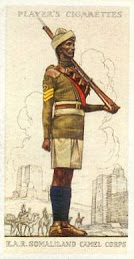
The first campaign to explore the possibility of exploiting air power's reach and power in this manner took place in British Somaliland in the Horn of Africa. A Muslim cleric Mohammed bin Abdullah, colloquially, if inaccurately known as "The Mad Mullah", had proved a thorn in the flesh of the colonial administration for many years and had frustrated repeated attempts to bring law and order to the area. In 1920 his activities had reached such a pitch that the Colonial Office again wished to take military action against him and his large band of armed followers. The British Army estimated that this would require a full scale expeditionary force involving 2 or 3 divisions of troops and attendant bag and baggage at a cost of several million pounds. Trenchard, however, offered to do the job using one squadron of de Havilland DH9s, in collaboration with the local gendarmerie regiment, the Somaliland Camel Corps and a battalion of the King's African Rifles. His offer was accepted and the Squadron of 12 aircraft, to be known as "Z Force" was shipped to the area.


In a matter of weeks, operating in conjunction with the Camel Corps, Z Force successfully bombed and harried the Mullah's forces, driving them from their traditional stone forts. The entire campaign cost in the region of £100,000, and it was said afterwards to be the "cheapest war in history". The political effects for the RAF were out of all proportion to the local impact in Somaliland. The RAF had demonstrated its ability to undertake effective police actions


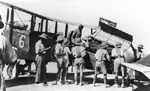
DH9 Air Ambulance with Z Force British Somaliland 1919

Source: http://www.raf.mod.uk/rafcms/mediafiles/F21C6257_ABD1_7132_E8716B8C2DA98948.pdf

Friday, May 01, 2009

Lieutenant-Colonel Eric Wilson, VC: Camel Corps officer

For valour: Wilson, who left the army in 1949, is seen here at a 1988 VC and GC Association reunion in London, with Gurkha holders of the decoration

For valour: Wilson, who left the army in 1949, is seen here at a 1988 VC and GC Association reunion in London, with Gurkha holders of the decoration

Somaliland, 1940: Wilson is seated in the front of the truck holding the dog. It was killed on the first day of the action in which Wilson was taken prisoner

Somaliland, 1940: Wilson is seated in the front of the truck holding the dog. It was killed on the first day of the action in which Wilson was taken prisoner

Eric Wilson won the first Victoria Cross to be awarded in the campaigns in Africa during the Second World War. His story is one of persistent yet seemingly nonchalant gallantry as, by his lights, he was simply doing what he was trained to do. He stuck to his precious guns to the bitter end and so certain was the brigade staff that he had been killed in the enemy’s final attack he was awarded a posthumous VC. But he survived to fight in two more campaigns.

Mussolini’s declaration of war on June 10, 1940, two weeks before the fall of France, found him with no enemy immediately to hand. He therefore ordered his forces in Abyssinia to attack the nearby British colonial garrisons. In August, three columns each of brigade strength with tanks and supported by bomber and fighter aircraft crossed into British Somaliland south of Hargeisa and headed for the Tug Argan pass leading to the seaport capital, Berbera, on the Gulf of Aden. The Somaliland Camel Corps delayed the advance from the frontier, covering as best it could preparation of the main defensive position astride the Tug Argan pass.

Wilson, then a captain, commanded the Camel Corps machinegun company. His task was to provide fire support for the Northern Rhodesia Regiment manning the central sector of the front across the enemy’s path. So far as the terrain allowed, he positioned his water-cooled Vickers medium machineguns where they could strike the enemy in the flanks when they moved forward. But, because of the width of the front, several had to be sited frontally with wide arcs of fire. Having briefed all his gun crews, he joined the most forward pillbox on Observation Hill overlooking the enemy’s main approach.

The Italian attack opened on the morning of August 11 with an artillery bombardment of Wilson’s positions. A shell of the first salvo exploded immediately outside the embrasure of his pillbox, blowing the Vickers off its tripod and wounding one of the crew. To Wilson’s surprise the weapon was undamaged and he had it in action again within minutes, but the next salvo killed the corporal in charge of the gun, wounded Wilson in the right shoulder and left eye and smashed his spectacles.

During the afternoon he detected an Italian mountain artillery battery working its way up from the road to the pass. He had its range and opened fire, only to receive an immediate retaliation from the enemy’s fixed-charge high-explosive shells. Counter-battery fire from his own artillery and a tropical downpour brought action to a halt for the day.

Next morning the Italians began to push forward small groups of infantry and artillery that worked their way along the sides of the Tur Argan gap to attack the British positions at close quarters. Then, on August 13, the enemy launched a large-scale assault, overran the British artillery position and renewed their fire on Wilson’s machinegun posts. On the 15th two of his guns were blown to pieces but he continued to man his own gun until the position was overrun. The citation for his VC, gazetted on October 11, 1940, opened with the words, “For most conspicuous gallantry on active service in Somaliland” and ended with, “The enemy finally overran the post at 5pm when Captain Wilson, fighting to the last, was killed.”

He had been taken prisoner, however, not just wounded but suffering from malaria. This only became known in April 1941 when the 5th Indian Division captured the prisoner-of-war camp at Adi Ugri in Eritrea, where Wilson was being held. Together with other prisoners, he had almost completed a tunnel for a mass escape attempt when they awoke one morning to find all their guards had gone. By then he had learnt of his award from an RAF officer who had been shot down and taken to the same camp.

Eric Charles Twelves Wilson was born in Sandown, Isle of Wight, the son of the Rev C. C. C. Wilson. He was educated at Marlborough and Royal Military College Sandhurst from where he was commissioned into the East Surrey Regiment in 1933. He had been attracted to Africa since boyhood through stories told by his grandfather, who had founded the Church Missionary Society station in Buganda in 1876. So, after four years with the East Surreys, he volunteered for secondment to the King’s African Rifles and served in Tanganyika with the 2nd (Nyasaland) Battalion until he secured a second secondment to the Somaliland Camel Corps in 1939.

On release from the Italian PoW camp he volunteered to join the Long Range Desert Group operating round the flanks of Rommel’s Afrika Korps in the Western Desert. His knowledge of desert conditions proved a useful asset but, at the end of the North African campaign, he went to Burma as second-in-command of a battalion of The King’s African Rifles. He took part in the advance of the 11th East African Division down the notoriously disease-ridden Kabaw Valley to establish a bridgehead over the Chindwin at Kelawa. He then contracted scrub typhus and spent two months in hospital before being medically downgraded and returned to East Africa. He spent the final months of the war commanding the Infantry Training Centre at Jinja in Uganda.

Wilson left the Army in 1949 to join the Overseas Civil Service in Tanganyika, where he served until independence of the British East African countries led to his retirement in 1961.

He joined the staff of the London Goodenough Trust for Overseas Students, where his fluency in Kiswahili, Gikuria and Chinyakusa stood him in good stead. He was the honorary secretary of the Anglo-Somali Society, 1972-77, and again from 1988 to 1990.

He married Anne Pleydell-Bouverie in 1943. The marriage was dissolved in 1953, and in that year he married Angela Joy, daughter of Lieutenant-Colonel J. McK Gordon. He is survived by his second wife, one of the two sons of his first marriage and one son of his second. His death leaves nine surviving holders of the Victoria Cross.

Lieutenant-Colonel Eric Wilson, VC, was born on October 2, 1912. He died on December 23, 2008, aged 96

http://www.timesonline.co.uk/tol/comment/obituaries/article5415089.ece

Thursday, April 30, 2009

RAF 1920 - Somaliland Camel Corps in British Somaliland

1920

A Z Force DH9 in air ambulance role Jan - Feb 1920- The RAF's first "little war". RAF units were involved in operations with the Camel Corps in British Somaliland (now Somalia) to overthrow Dervish leader Mohammed bin Abdullah Hassan, the "Mad Mullah". The airborne intervention was "the main instrument and decisive factor" in the success of the operation. Ten dH9s were dispatched to form "Z Force", and were used for bombing, strafing and as air ambulances.

Royal Air Force College Cranwell 5 Feb 1920- The RAF College opened at Cranwell, Lincolnshire.

1 Apr 1920- The WRAF was disbanded.

3 Jul 1920- Over 60,000 spectators attend the first RAF Pageant at Hendon, London.


Source: http://www.raf.mod.uk/history/raftimeline19181929.cfm

Somaliland: UK ignores potential commonwealth member

The Prime Minister at that time, Harold Macmillan, told the House of Parliament:
“I should like to say, however, that it is Her Majesty’s Government’s hope that whatever may be the constitutional future of the Protectorate, the friendship which has been built up between its people and those of the United Kingdom for so many years will continue and indeed flourish.” – [Official Report, 11 April 1960;Vol.621,c.104W.]


By Jamal Ali Hussein

6 November 2007

As the Commonwealth countries meeting is about to start in Uganda during November 2007, the United Kingdom citizens who are originally from Somaliland are currently worried about the situation of their original mother country. They are amazed by the lack of Britain’s role in leading the way to promote Somaliland to a successful re-recognition. Somaliland Community particularly want the British Government to remember the words of its Prime Minister Harold Macmillan during early 1960s when Somaliland was about to receive its independence from Britain. The Prime Minister at that time, Harold Macmillan, told the House of Parliament:

“I should like to say, however, that it is Her Majesty’s Government’s hope that whatever may be the constitutional future of the Protectorate, the friendship which has been built up between its people and those of the United Kingdom for so many years will continue and indeed flourish.” – [Official Report, 11 April 1960;Vol.621,c.104W.]

Somaliland Republic (former British Somaliland) received its independence from Britain on June 26 th, 1960, and it was immediately recognized by 34 UN Member States, including the five Permanent Members of the Security Council. This made Somaliland to be the first independent Somali country to become a member of the United Nations before uniting voluntarily with the Italian Somaliland (current Somalia) on July 1 st, 1960 to form what was known as the Somali Republic in pursuit of irredentist dream of “Greater Somalia” including parts of Ethiopia, Kenya, and Djibouti. Somaliland decided to re-instate its sovereign independence from Somalia after the fall of Siyad Barre regime in 1991. Somaliland is only seeking re-recognition within the borders received at the time of independence from Britain 1960. Somaliland, not officially re-recognized by any state, has been functioning as a constitutional democracy with a president directly elected by the people, added by a parliament and local government also directly elected by the people. Somaliland’s existing multi-party democracy system is rarity in Africa and the Muslim world.

British Somaliland was either a protectorate or colony for Britain nearly 80 years. Somaliland Scouts regiment even played an important role during Second World War. There is no doubt that Somaliland people feel let down by the British Government since Somaliland re-instated its sovereignty due to their historical relationship. But with Prime Minister Brown’s government, Somalilanders are hopeful that Britain will look into Somaliland’s re- recognition issue with fresh eyes. It is important to note that Somaliland is one of few African countries where the government does not receive a budgetary support from the international community; it is one of only few African countries where the President is directly elected by the people. Yet, no government came forward to recognize it. It has been reported that several countries had indicated that they do not want to be the First, but the 2 nd or the 3 rd etc to re-recognize Somaliland. Mr. Eid Ali Ahmed, member of Somaliland Societies in European and Chartered Fellow of UK Institute of Personnel and Development said “There is a long history between the people of Somaliland and the United Kingdom people. The people of Somaliland strongly believe that they need to have a powerful sponsor like East Timor, and Kosovo had in order to persuade the International Community start listening its voice, and that is where United Kingdom (Commonwealth leader) should have come in”. Mr. Eid Ali Ahmed added “ Somaliland is not the first nation that entered a voluntarily union and subsequently withdrawn from the union. Senegal and Gambia, Egypt and Syria, Senegal and Mali have all done likewise.”

It is important to note that a number of British members of Parliament visited Somaliland in many occasions, and encouraged the British Government to look into the Somaliland re-recognition issue. The most memorable debate on Somaliland issue in the house of British Parliament is the one organized by the Hon. Member for Clydebank and Milngavie (Tony Worthington) in 2004 after he and other honorable members just returned from a visit in Somaliland. There was no one who could make a better case for Somaliland re-recognition than those British MPs. The honorable Tony Worthington said during the debate “ Somaliland has rebuilt its country without international assistance. It has acted totally on democratic lines, and the demand for independence was supported in a referendum by more than 90 percent of the population. The level of stability is impressive. I was far more impressed with the country than those of several other African countries that I have visited – countries that we recognize and support. Somaliland is doing nearly everything right, but it is being ignored.” The British MP in addition said “It is worth noting that Somaliland people supported, and stood shoulder to shoulder with Britain during the Second World War.”

The private sector in Somaliland is thriving, and now boasts of several private airlines, four electricity companies and five telecommunications companies, which offer both mobile and landline telephone services. People of Somaliland would tell you that they did not have any of those businesses for 31 years of marriage with Southern Somalia. One of the most remarkable aspects of Somaliland achievements include the major contributions made by the Somaliland Diaspora community particularly the ones living in the United Kingdom, Europe, Middle East, and North America.

Somaliland residents in Britain have pleaded with the UN not to deny Somaliland the right guaranteed in Article 3 of the Universal Declaration of Human Rights. The people of Somaliland are questioning the world community's action as it also contradicts Articles 15 (1) and (2) which states that "everyone has the right to nationality" and that "no one shall be arbitrarily deprived of his nationality nor denied the rights to change his/her nationality respectively." The action runs counter to the International Covenant on Economic, Social and Cultural rights -Article 1 which states that "all peoples have right of self-determination. By virtue of that right, they freely determine their political status and freely pursue their economic, social and cultural development". In the absence of codified rules, it seems that the conventional wisdom has been that states recognize or do not recognize other states on the basis of their selfish interests. In last January at a high-level meeting in Brussels, organized by Somaliland Societies in Europe and Somaliland Community in Belgium (SBC), Mrs. Gleyns Kinnock the Labor Member of European Parliament for Cardiff said, “Somalilanders’ pleas for international recognition for their country must be heard. The right to self-determination for all peoples is a fundamental principle enshrined in the UN Charter. Indeed, it is an anomaly that Somaliland is still denied recognition by the international community."

In last December Kerry McCarthy Member of UK Parliament and secretary of UK All Party Parliamentary Group for Somaliland said “ Somaliland needs the protection of the international community if it is to maintain its position as beacon of stability in a troubled region. Formal recognition of its existence as an independent sovereign state would be a significant first step.” The president of Somaliland Dahir Rayale Kahin made a speech in the British Parliament a couple of years ago, and many times repeatedly shown his concern by saying “Lack of re-recognition could mean that Somaliland cannot enter a formal trade agreements with other nations or seek assistance from financial institutions although the country has unexploited opportunities.”

The opposition leaders in Somaliland have a common stand on the issue of re-recognition with the President and the government. Mr. Faisal Ali Warabe, Somaliland’s UCID opposition party leader, and a presidential candidate in 2008 asks “"Somaliland was a recognized country until its leaders illegally merged with southern Somalia. Why is the international community reluctant to honor the wishes of the same country that now wants to go back to its statusquo ante (original status as a country)? Somaliland simply wants its UN seat back”. In addition, Somaliland’s other KULMIYE opposition party leader, and also a presidential candidate in 2008 Mr. Ahmed Mohamed Sillanyo states “Will the International Community respect the choice of the Somaliland people? Will Britain do its moral duty to influence and lead the international community to respect the choice of Somaliland people as it once did back in 1960? Will Somaliland be considered as a Commonwealth member during the upcoming meeting?”

Jamal Ali Hussein, Chief Executive Officer/Managing Director of Citibank Cote d’Ivoire – WEST AFRICA.

First published 6 Nov 2007 Kenyan "People Daily" Newspaper.

http://www.somalilandtimes.net/sl/2007/303/05.shtml

Monday, May 19, 2008

Air Chief Marshal Sir John Barraclough

Wartime flying boat pilot of high ability who made his career in the RAF and flew more than 70 types of aircraft.


Air Chief Marshal Sir John Barraclough
Barraclough [right] ready for his flight in a Tornado to mark his retirement as Inspector of the RAuxAF in 1995

Air Chief Marshal Sir John Barraclough, who died on Saturday aged 90, gave an exceptionally long period of devoted service to the Crown and to defence affairs; after serving in the RAF for 38 years, in retirement he conducted various studies for the Air Force Board and the Chiefs of Staff before becoming the Inspector-General of the Royal Auxiliary Air Force.

During the Second World War Barraclough flew continuously on maritime air duties with Coastal Command and in the Indian Ocean. Before the war he flew Ansons with No 269 Squadron from Abbotsinch, near Glasgow, and, in a foretaste of what lay ahead, he was engaged in the air searches for the submarine Thetis when it failed to surface in Liverpool Bay in 1939.

On the outbreak of war he converted to flying boats, and in 1940 he operated with No 240 Squadron from the Shetland Islands. Flying over the northern North Sea he flew in support of the ill-fated British Expeditionary Force to Norway and on searches for German ships seeking to break out from the Baltic.


After a period flying anti-submarine patrols and convoy escorts off the west coast of Scotland, he was made chief instructor of the Flying Boat Conversion Unit at Invergordon, where he was awarded an AFC for developing innovative methods of operational training.

In February 1942 Barraclough reformed No 209 Squadron, equipped with the Catalina flying boat, before leaving in June for the Indian Ocean to support the Eastern Fleet for the Madagascar campaign.

Operating with the barest facilities from Comoro Island in the Mozambique Channel, and from other island bases, he flew intensive operations and was awarded a DFC. "This officer," the citation concluded, "has shown the greatest devotion to duty and is a born leader of men."

Barraclough continued to operate with No 209 over vast areas of the Indian Ocean, providing convoy escorts and seeking out U-boats and their mother ship, Elizabeth Schliemann.

Promoted to wing commander at the age of 24, he commanded the captured Italian airfield at Mogadishu, Somaliland, where Wellingtons conducted anti-submarine operations. On his return to Britain in May 1944 he became chief instructor at a flying-boat training unit and was mentioned in dispatches.

John Barraclough was born at Hounslow on May 2 1918 and educated at Cranbrook School. After three years' volunteer service with the Artists' Rifles while working in the City of London, in 1938 he was granted a four-year commission in the RAF to train as a pilot.

At the end of the war Barraclough was negotiating his admission to the Middle Temple as a student when he was offered a permanent commission in the RAF, which he accepted.

After completing a period of service in Egypt, he joined the Central Flying School and was appointed to its examining wing, first as a flight commander and then in command of the wing responsible for the flying instructional standards in the RAF and in many other national air forces which held the RAF in esteem.

As a staff officer at the headquarters of Training Command, he wrote an imaginative paper on the pros and cons of using a basic jet aircraft for initial pilot training, and this paved the way for the introduction into service of the long-serving Jet Provost aircraft.

Barraclough was always a restive staff officer who hankered after action – in his career he flew more than 70 different types of aircraft – and he was able to persuade his commander-in-chief that he should take the first Vampire training aircraft on a trial flight to Southern Rhodesia.

With few navigation aids, Barraclough and his fellow pilot completed the 10,000-mile round trip in the cramped cockpit of the short range, single-engine jet without mishap. He was awarded a Queen's Commendation for Valuable Services in the Air.

After commanding the two fighter stations at Biggin Hill and Middleton St George (now Durham Tees Valley Airport), he served in the Far East during the campaign against the Communist terrorists in Malaya.

On promotion to air commodore in 1960 he took up the post of director of public relations at the Air Ministry, where he was deeply involved in defending the philosophy and strategy of nuclear deterrence then exercised by Bomber Command; he also defended (in the end unavailingly) the emerging TSR2 from its political opponents. His efforts on these sensitive issues were recognised with a CBE.

On completing his time as AOC No 19 Group in Coastal Command, Barraclough took a sabbatical and, at his own expense and on unpaid leave, enrolled on the advanced management course at Harvard Business School.

On his return in 1968 the RAF appointed him Air Officer (Administration) of Bomber Command to manage the imminent, and highly emotional, mergers of Bomber, Fighter, Coastal and Signals Commands. Such was his success that he was promoted and appointed CB.

He served as Vice-Chief of the Defence Staff before becoming the Air Secretary, an appointment he did not relish. His final post before retiring from the RAF in 1978 was as Commandant of the Royal College of Defence Studies. He was appointed KCB in 1970.

Barraclough had a sharp intellect, a dry wit and boundless energy and enthusiasm. He was an eloquent and persuasive writer, and after retirement from the RAF was much in demand. For 12 years he served as a commissioner and vice-chairman of the Commonwealth War Graves Commission.

In 1976 he had been appointed an honorary air commodore in the Royal Auxiliary Air Force and, with the force employed in the ground defence role, he found himself very much at home as a former territorial rifleman.

For five years he was Inspector-General of the RAuxAF, during which time he was appointed a Gentleman Usher to the Sword of State with occasional ceremonial duties. He was able to take advantage of an informal opportunity after a State Opening of Parliament to seek the Queen's agreement to the award of a Colour.

This was granted, and in June 1989 750 serving members of the RAuxAF paraded at RAF Benson on the occasion of the presentation of the Queen's Colour.

On his farewell as the Inspector in 1995, Barraclough flew a bombing sortie in a Tornado. It was the 57th anniversary of his first flight in the RAF.

For six years in the 1970s he was editorial director of the defence magazine NATO's Nations. He was also a co-author, with General Sir John Hackett, of the best-selling book The Third World War, to which he contributed the air aspects.

In 1980 he became president of the Air Power Association, and the next year sponsored the Barraclough Trophy, awarded annually to the unit or individual member of the RAF who has made an outstanding contribution to RAF public relations in the previous year.

Barraclough was chairman of the Royal United Services Institute for Defence Studies, and then vice-chairman of the Air League, receiving its Gold Medal for distinguished services to British aviation. He was elected a Fellow of the Royal Aeronautical Society, and was a Liveryman of the Guild of Air Pilots and Air Navigators.

In 2002 he was approached to support an initiative to commemorate all those who had lost their lives in Coastal Command. He was appointed chairman of the Maritime Air Trust, which under his guidance and management launched a formidable fund-raising programme with the Duke of Edinburgh as its very supportive patron.

On March 16 2004 the Queen dedicated a sculpted tribute and roll of honour in the south cloister of Westminster Abbey. Barraclough – who, aged 86, handed over the reigns of the Trust to a former Chief of the Air Staff, Sir Peter Squire – always considered it an honour to have been associated with the project.

Barraclough lived in Bath, where in later years he was invited to be chairman, and later president, of the city's Royal Crescent Society, an organisation he led with his usual vigour in countering the adverse local effects of un-managed tourism.

He was a fine sailor and horseman. In the Admiral's Cup of 1973 he navigated the Irish yacht Clarion to success in her division of the Fastnet race. In the winter he rode regularly to hounds wherever he found himself, and he followed three-day eventing with keen interest.

He was a past-president of the RAF Modern Pentathlon Association and of the Combined Services' Equitation Association. He listed amongst his hobbies, "stilt walking (retired)".

John Barraclough was a tall man with a commanding presence but an unassuming manner. After being diagnosed with terminal cancer he displayed stoical courage.

Shortly before his death he paid tribute to his late wife Maureen (née McCormack), whom he had married in 1946 (and who died in 2001), writing that "her devoted and unselfish support during a taxing career was quite simply immeasurable". He is survived by their daughter.

source: http://www.telegraph.co.uk/news/obituaries/1947293/Air-Chief-Marshal-Sir-John-Barraclough.html